

A second brain for founders that every AI tool reads first.
An AI second brain for founders is one local folder of Markdown files that every AI tool reads before it starts work: a map, rules, value cards and projects, kept up to date by Claude skills each day. It suits founders who post, sell and decide from their own notes. A fixed setup sprint takes about 2 weeks, for US$1,800.
Every AI session starts from zero: you paste the same context, repeat the same corrections, and lose the good ideas from podcasts, calls and threads. For a founder who posts, sells and decides every day, rebuilding that context is the slowest part of the work.
Skip this if you use one AI tool for a few chats a week. Its built-in memory will do.
- What you get
- A Markdown brain with a map, locked folders and indexes, rules, and your skills pointed at it
- Setup
- About 2 weeks, then about 35 minutes a day to run
- Price range
- Sprint US$1,800, then from US$599 a month
- We need from you
- Your notes, documents and past posts, and the AI tools you already use
Kept, mapped, read first.
What does a second brain for founders do?
It keeps what is worth keeping as short notes in one local folder, and a map file tells every AI tool what to read first. Skills turn what comes in into a scored shortlist and draft posts, and the founder picks. Each correction becomes a rule, so the next draft starts from it.
One value card per source: podcasts, threads, calls, voice notes and AI sessions, distilled to takeaways, not raw transcripts.
AGENTS.md is the map: five rules, a routing table and a load order, kept under 200 lines. Every folder has its own index.
Skills triage and score signals into a shortlist and draft LinkedIn, X and Reddit posts. AI only shortlists; the founder picks.
Each correction becomes a one-line rule, and a Monday cleanup checks the rules for duplicates and conflicts.
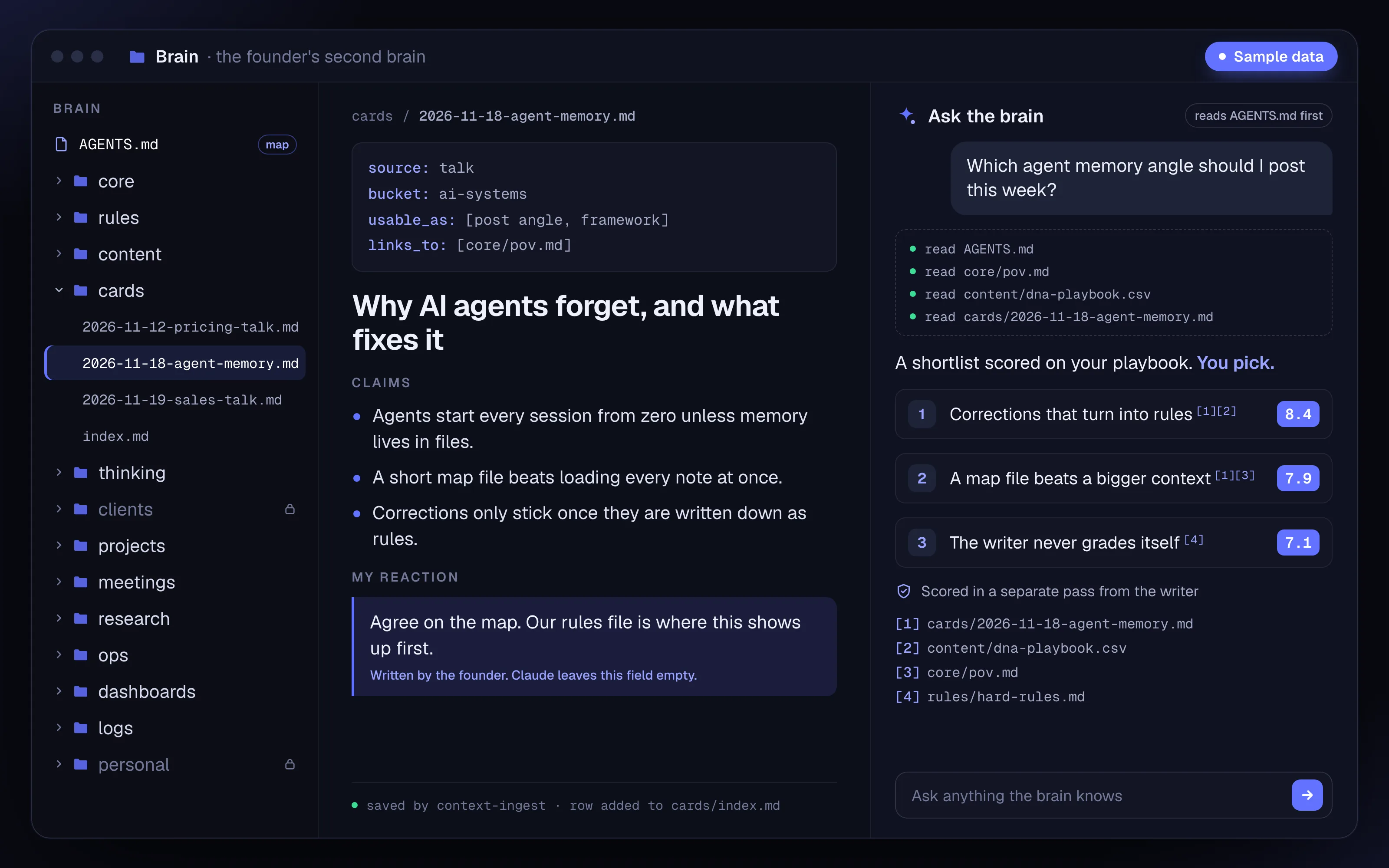
One folder, with the founder choosing.
How does the second brain stay up to date?
Skills write to it as part of the day's work, and a rhythm keeps it honest: daily triage and ingest, weekly real numbers, monthly skill tuning and pruning, and a re-tune of the writers on each new model.
What goes in
Things worth keeping, voice notes and AI sessions, real post results, and corrections.
Where it lives
One Markdown folder: the AGENTS.md map, 13 folders with an index each, and local git history.
What reads it
Ingest, triage and score, the writers and loop-tune, each reading the map before it starts.
Who decides
The founder picks from the shortlist and corrects the drafts. Corrections become rules.
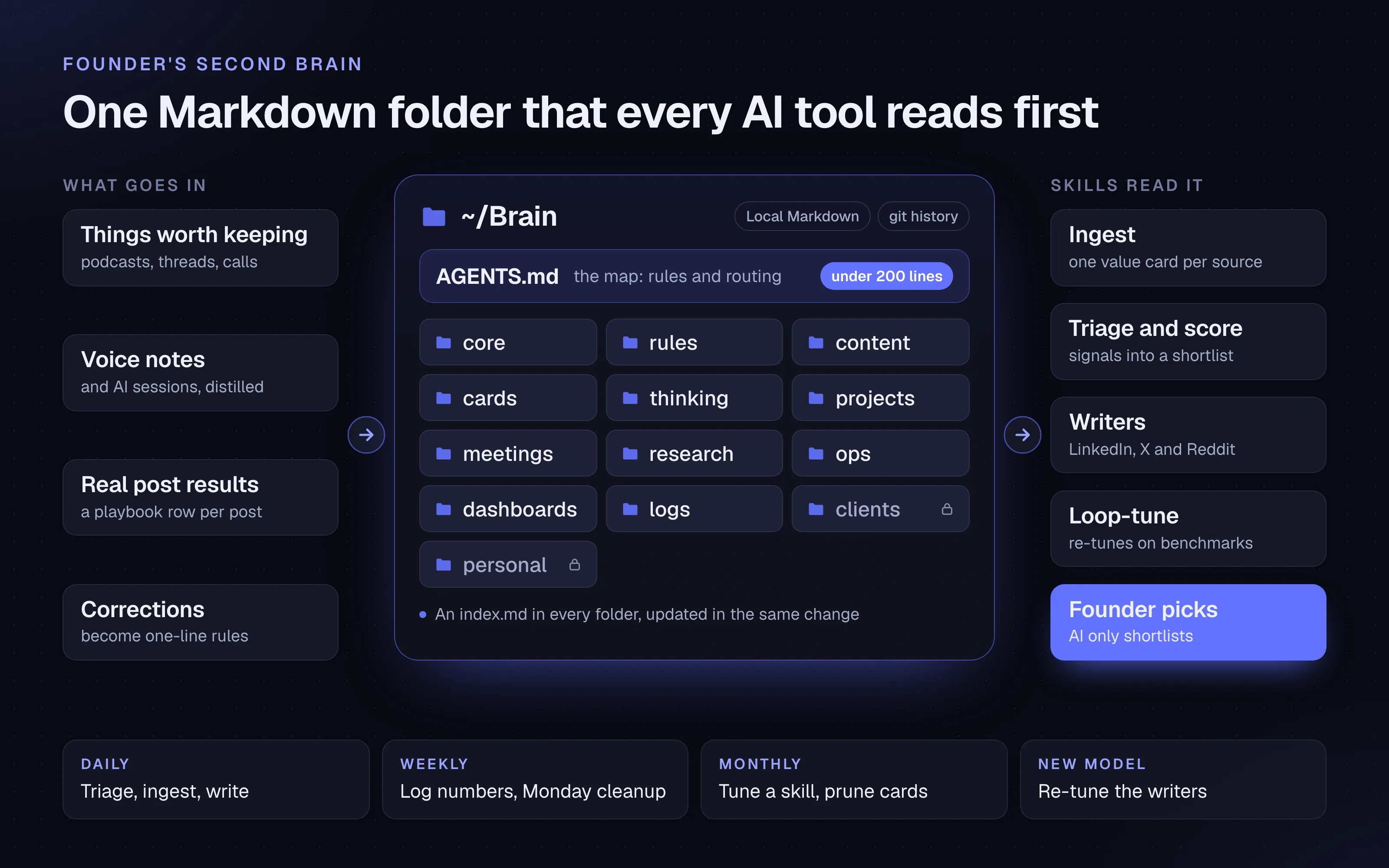
Sprint first, then keep it tuned.
How much does a second brain for founders cost?
A fixed setup sprint is US$1,800 for about 2 weeks. It scaffolds the folder and map, backfills the core files from your own words and documents (never invented), points your skills at the brain and sets the cadence. After that, an AI consulting package keeps it tuned, from US$599 a month.
Setup sprint
The folder, map and indexes, the core files backfilled from your own words, your skills pointed at it, and the cadence set.
- Time
- About 2 weeks
- Price
- US$1,800 fixed
- Ends with
- A brain every AI tool reads first
Advisory
An advisor on call: a monthly review, skill tuning and pruning, and a re-tune of the writers when a new model lands.
- Time
- Monthly · 20 h
- Price
- US$599 a month
- Ends with
- A review every month
Fractional
A fractional AI lead adds new skills and agents on the brain and tunes the writers on your real post results.
- Time
- Monthly · 80 h
- Price
- US$2,399 a month
- Ends with
- More of the week run from the brain
Team
An AI lead plus 2 engineers, when the brain grows into a company brain for your team.
- Time
- Monthly · 320 h
- Price
- From US$9,599 a month
- Ends with
- One method across the company
In US dollars · Claude and other tools paid at cost, straight to the provider · How NorthStar charges
No tool to lock you in.
What is a founder's second brain built on?
Plain Markdown and local git, read by Claude Code. The skills sit outside the folder and read from it; the routing table in the map names 16 of them.
Plain Markdown
Every card, rule, project and index, in files any tool can read.
The map and indexes keep tools from loading every note at once.
Local git
Version history for every change to the brain.
It stays on your machine.
Claude Code
CLAUDE.md imports AGENTS.md, so every session loads the same map.
Other tools read the same map file.
Skills
Ingest, triage and score, the writers and loop-tune, kept in ~/.claude/skills.
They read from the brain and write back to it.
Obsidian
For reading and fixing notes by hand.
Optional: the brain works without it.
It remembers. You decide.
The brain is built to hold takeaways, not everything, and the AI that writes never marks its own work.
Secrets never go in the brain, in any folder.
It stores what was worth keeping, not raw transcripts or data exports.
Client and personal folders are kept apart from the rest of the brain.
Drafts are scored in a separate pass, and the founder picks what goes out.
Proof
A 116-line map, 13 folders with an index each, and 16 skills on the routing table. The work page shows the folder, the skills and the daily rhythm.
Questions
How much does a second brain for founders cost?
The setup sprint is US$1,800, fixed, for about 2 weeks. After that, Advisory is US$599 a month, Fractional US$2,399 and a team from US$9,599. Claude and any other tools are paid at cost, straight to the provider.
How much of my time does it take?
About 35 minutes a day once it runs: triage and ingest daily, real numbers weekly, and skill tuning and pruning once a month.
Will it sound like me?
The core files are filled from your own words and documents, never invented, and every correction becomes a rule. The writers draft, a separate pass scores, and you pick.
Do I have to use Claude?
It is set up for Claude Code, which loads the map in every session. The brain itself is plain Markdown, so the same map works for other tools that read files.
Where does my data live?
On your own machine, in plain files with local git history. No passwords or keys go in, and client and personal folders are kept apart.
Get this scopedin 30 minutes.
Bring the AI tools you use and a week of notes if you can. You leave with a written next step and the sprint scoped.
Your time zone · you confirm on the next step