

A company brain your team can ask, with a source on every fact.
A company brain for teams is one Markdown folder that every Claude session reads first: decisions, people, rules, workstreams and open loops, each fact with its source, while raw data stays in its own tools. It suits services firms and growing teams. We build it in 7 phases, starting with a fixed sprint of about 2 weeks for US$1,800.
Decisions sit in chats, meetings and inboxes, and every new AI session starts without them. For a team where the same questions come up every week, nobody can say quickly what was decided, who owns it, or what is waiting on whom.
Skip this if a few people can still keep the whole picture in their heads. A shared doc will do.
- What you get
- A brain with a map, locked folders, templates, three skills and three routines, filled from approved sources
- Setup
- 7 phases, each one waiting for the owner's go-ahead
- Price range
- Sprint US$1,800, then from US$599 a month
- We need from you
- One owner to reply after each phase, the sources you approve, and your own Claude account and hardware
Distilled, sourced, asked.
What does a company brain for teams do?
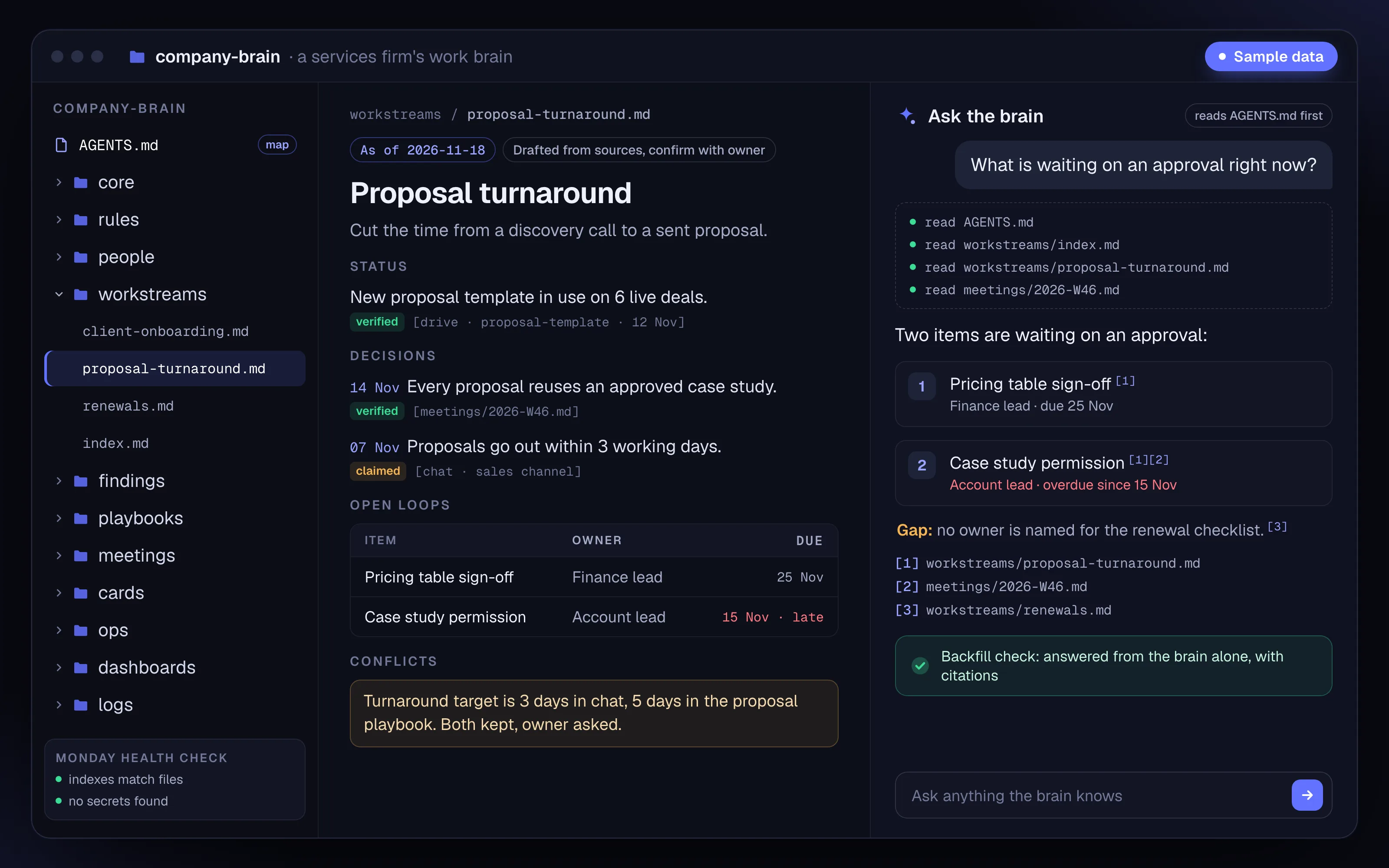
It holds what the team needs to know, distilled: decisions, people, rules, workstreams and open loops. Every fact carries a source and a label, and anyone can ask it a question and get the answer with the files it came from.
An AGENTS.md map under 200 lines and locked folders for core, rules, people, workstreams, findings, playbooks, meetings, cards, ops, dashboards and logs, each with an index.
Each claim is labelled verified, claimed, inferred or assumed, and conflicting facts are kept and flagged for the owner.
Ask what is waiting on an approval, and the answer lists each item with the file it came from.
Three routines: an end-of-day distil, a Monday health check and a Friday weekly update draft.
Built in phases, with the owner saying next.
How is a company brain built?
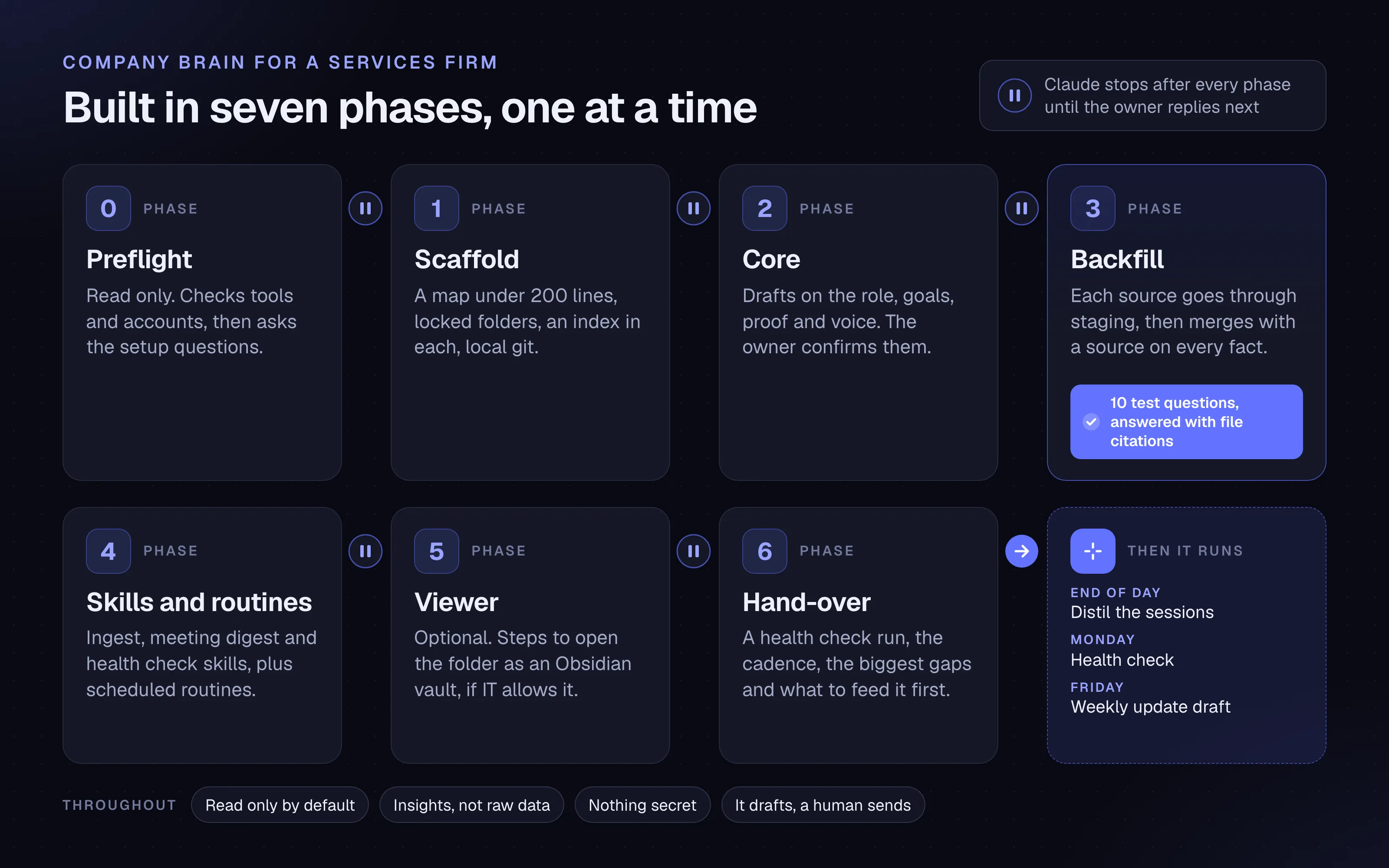
In seven phases, and Claude stops after each one until the owner replies "next". In backfill, each source runs into a staging folder first; Claude then removes duplicates, flags conflicts and merges, with a source on every fact. Backfill passes only when the brain answers 10 test questions on its own, citing file paths.
Preflight
Read only. Checks tools and accounts, agrees the sources, then asks the setup questions.
Scaffold
A map under 200 lines, locked folders, an index in each, and local git.
Core
Drafts on the role, goals, proof and voice, which the owner confirms.
Backfill
Each source through staging, then merged with a source on every fact, and checked with 10 test questions.
Skills and routines
Ingest, meeting digest and health check skills, plus the scheduled routines.
Viewer
Optional. Steps to open the folder as an Obsidian vault, if IT allows it.
Hand-over
A health check run, the cadence, the biggest gaps and what to feed it first.
Every week
End of day, distil the sessions. Monday, the health check. Friday, the weekly update draft.
Sprint first, then feed it.
How much does a company brain cost?
A fixed sprint is US$1,800 for about 2 weeks: preflight with your sources approved, the scaffold, and the core files drafted for the owner to confirm. An AI consulting package then carries the backfill, the skills and routines, and the hand-over, from US$599 a month. Plan on 12 to 18 weeks of daily feeding before the brain works as expected.
Sprint
Preflight, scaffold and core: sources approved and read only, the map and folders set up, the core files drafted for the owner.
- Time
- About 2 weeks
- Price
- US$1,800 fixed
- Ends with
- A brain ready for backfill
Advisory
An advisor on call: a monthly look at the health check, the gaps, and what to feed it next.
- Time
- Monthly · 20 h
- Price
- US$599 a month
- Ends with
- A review every month
Fractional
A fractional AI lead runs the backfill and its 10-question check, the skills and routines, and the hand-over.
- Time
- Monthly · 80 h
- Price
- US$2,399 a month
- Ends with
- A brain the team asks every day
Team
An AI lead plus 2 engineers, for a brain across several teams or many more sources.
- Time
- Monthly · 320 h
- Price
- From US$9,599 a month
- Ends with
- One method across the company
In US dollars · Claude and other tools paid at cost, straight to the provider · How NorthStar charges
Nothing new to host.
What is a company brain built on?
Claude on the company's own account and hardware, plain Markdown and local git with no remote. Raw data stays in the tools it lives in today.
Claude, in the desktop app's Code tab
Builds the brain phase by phase and answers from it.
Runs on the company's own Claude account.
Plain Markdown
The map, the folders, the indexes and the templates.
Distilled insights only; raw data stays in its own tools.
Local git
Version history for every change to the brain.
No remote: it stays on company hardware.
Skills and scheduled tasks
Ingest, meeting digest and health check, and the end-of-day, Monday and Friday routines.
Skills live in ~/.claude/skills, outside the brain.
Obsidian
A viewer for the folder.
Optional, and only if IT allows it.
It drafts. A person sends.
The brain reads and remembers. Anything that leaves it, an email, a message, an update, goes out only after a person sends it.
Connectors read only, from the sources approved in preflight, for the last 90 days.
No passwords, keys or secrets in the brain, and the Monday health check looks for them.
Verified, claimed, inferred or assumed, with the source next to it.
Call recordings are not processed until they are cleared.
Proof
The work page shows the phases, the folder and a sample screen. The client stays unnamed.
Questions
How much does a company brain cost?
The first sprint is US$1,800, fixed, for about 2 weeks. After that, Advisory is US$599 a month, Fractional US$2,399 and a team from US$9,599. Claude and any other tools are paid at cost, straight to the provider.
How long until it is useful?
Each phase moves at the owner's pace. The method plans on 12 to 18 weeks of daily feeding before the brain works as expected, and the backfill check shows early whether it can answer from its own files.
Does our data leave the company?
The brain runs on your own Claude account and hardware, in plain Markdown with local git and no remote. Raw data stays in its own tools; the brain keeps distilled insights.
Can it send emails or change our tools?
No. It is read only by default. It drafts, and a person sends.
How do we know an answer is right?
Every fact carries a source and a label, conflicts go to the owner, and each answer cites the files it used. Backfill passes only when 10 test questions are answered from the brain alone.
Get this scopedin 30 minutes.
Bring the questions your team asks every week. You leave with a written next step, the sources to start with, and the sprint scoped.
Your time zone · you confirm on the next step