

Swarm Studio: rehearse how people will react before it happens.
Swarm Studio is our open-source app that rehearses how people will react to a launch plan, a policy draft or a news story. Claude builds a knowledge graph, plays the people involved and a crowd on a simulated microblog and forum, polls every agent and writes a visual report you can question.
- License
- MIT
- Runs on
- Your own Claude plan
- Agents
- 10 to 300 a run
At a glance
- For whom
- Anyone testing a launch plan, a policy draft or a news story before it goes out
- What it is
- An open-source app under the MIT license, inspired by MiroFish and rebuilt from scratch
- Runs as
- A private claude.ai artifact on your own Claude plan, with no API key, server or other service
- Run size
- 10 to 300 agents over 2 to 60 rounds
- You get
- A report with headline numbers, takeaways, seven charts and a card for every agent, as .md or .pdf
- Good to know
- One run is a simulated, plausible world, not a forecast. Your simulations stay private to you
You only see the reaction once it has happened.
A price change, a launch or a policy lands on many people at once, and the first time you hear how they take it is usually after it ships. Swarm Studio gives you a rehearsal first: the people in your material, plus a crowd of the public, argue it out on a simulated feed and forum.
It is one simulated run of a plausible world, not a forecast. What it gives you is the arguments, the shifts in stance and the issues that came up, while there is still time to change the plan.
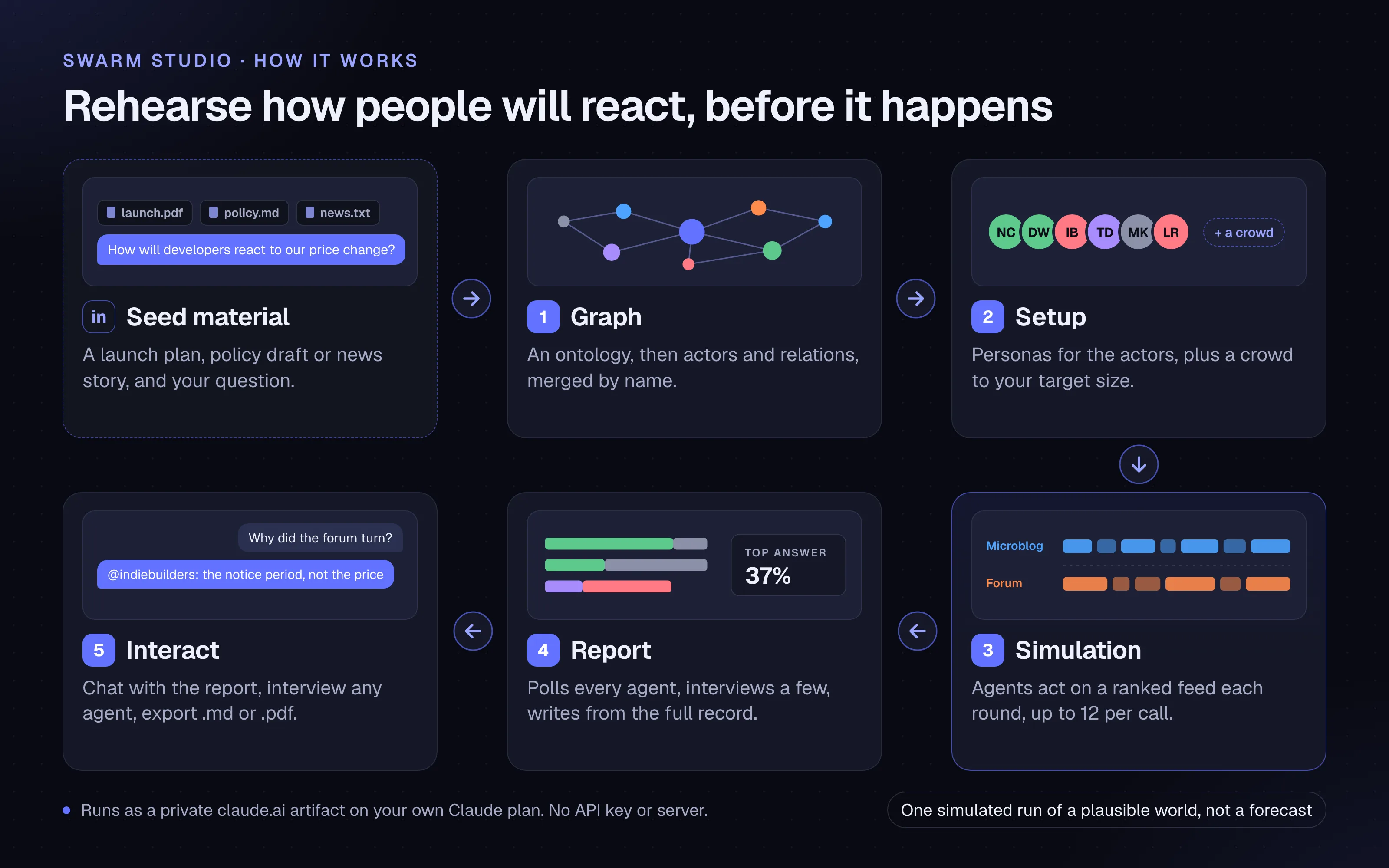
Five steps, all run by Claude.
How does an AI reaction simulation work?
You give it source material and a question. Claude does the rest, round by round, and saves progress after every round so an interrupted run resumes where it stopped.
Map who is involved
Designs an ontology, pulls out the actors and their relations from your material, and merges them by name.
Cast the agents
Writes personas for the actors, plans audience segments, fills the crowd to your target size, and sets the clock and opening posts.
Play it out
Each round, each platform picks active agents by activity and hour of day and ranks a feed for each. One call plays up to 12 agents.
Poll and write it up
Polls every agent, interviews chosen ones, and a tool-using agent searches the full record to write each section.
Ask follow-ups
Chat with the report agent, or interview any agent in character.
One paste to install
One paste into Claude Code, or a plugin install, publishes the app to your account. After that you only need the link.
What is Swarm Studio built with?
A single page that runs inside claude.ai, so there is nothing to host and no API key to manage. A local version runs the same pipeline on your own machine.
What does a Swarm Studio report look like?
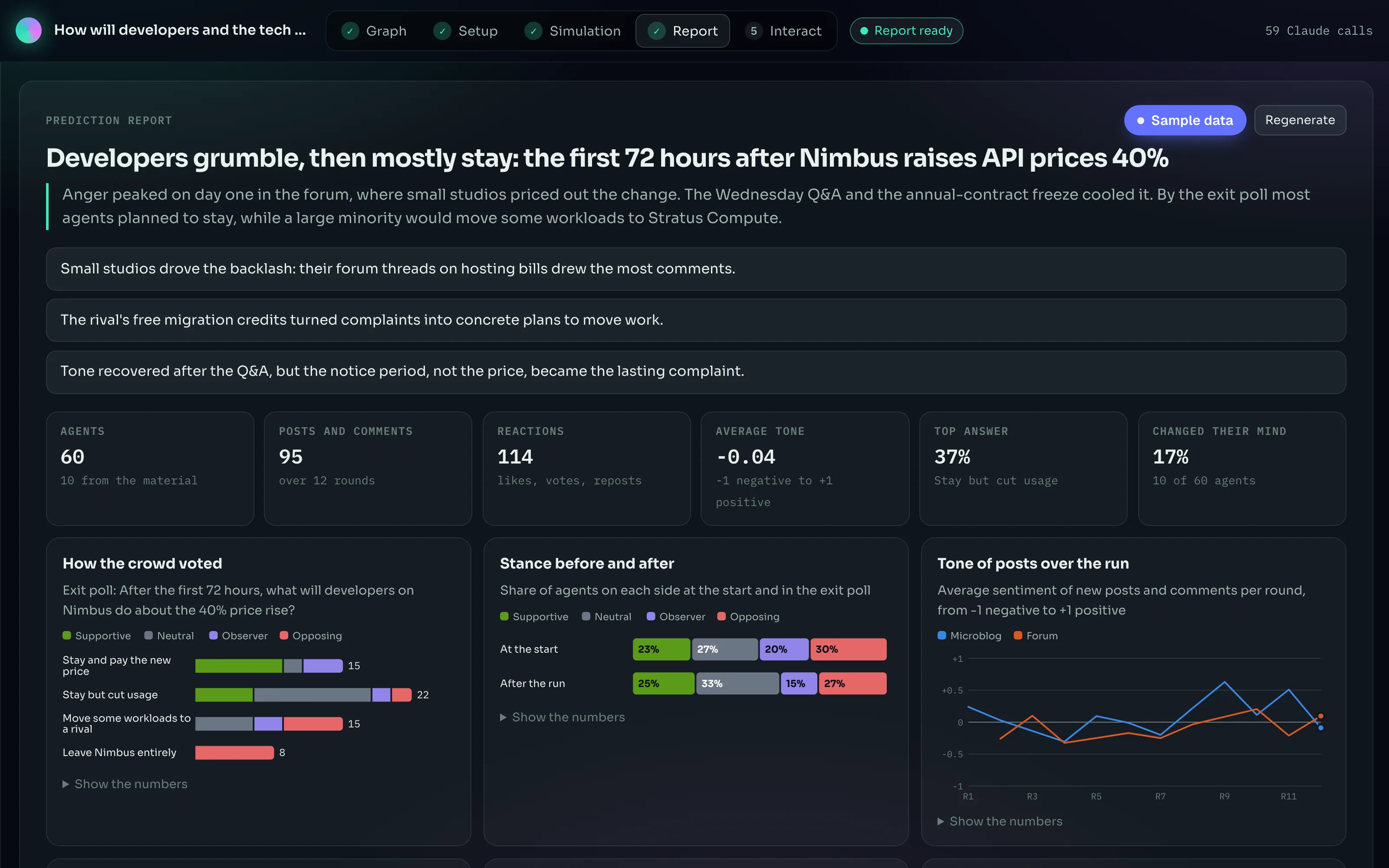
A drawing of the flow, and the real app's report from a sample run: the app's own example of a cloud provider raising API prices, with 60 agents over 12 rounds and fictional replies from its offline test engine.
Sample data · the report screen is the real app, run on its offline test engine
What does Swarm Studio prove?
That a multi-agent system can run end to end on a plan you already pay for, and turn into a report a team can read and question. It is free to use under the MIT license.
AI agents and automation
Agents for marketing, sales and operations, with a person signing off.
Service: AI agents →Growth strategy and fractional CMO
A go-to-market plan for your launch, from a sprint to a fractional CMO.
Service: growth strategy →AI consulting
Where AI pays off for you, with a ranked roadmap in 2 weeks.
Service: AI consulting →Get the app